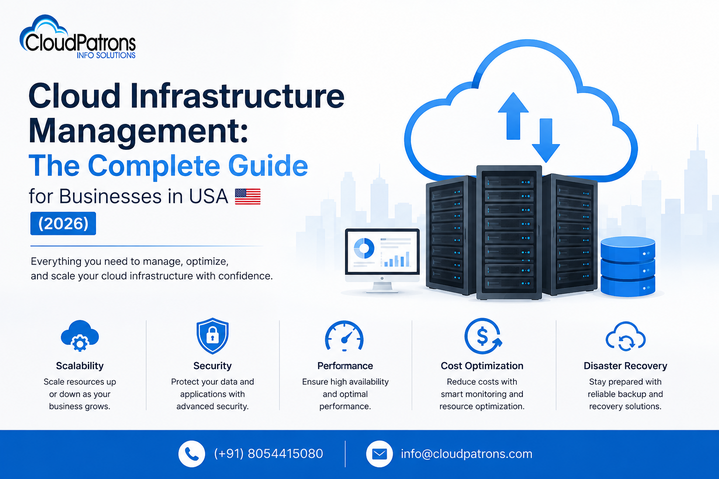
What Is Cloud Infrastructure Management?
Cloud infrastructure management is the practice of configuring, monitoring, optimizing, and securing an organization's virtualized computing, storage, and networking resources across cloud environments. It bridges the gap between raw hardware provided by cloud services and the applications your business relies on, ensuring systems stay scalable, reliable, and cost-effective.
Rather than managing compute, storage, and networking independently, a mature infrastructure strategy unifies these elements under a single governance layer combining automation, observability, cost control, and security into one operating model. This guide covers every technical layer of that model and exactly how to choose the right approach if you're evaluating options in the USA, backed by the same discipline Cloud Patrons Info Solutions in India brings to every cloud engagement.
It's the end-to-end discipline of provisioning, monitoring, securing, and optimizing cloud resources (public, private, hybrid, or multi-cloud) so they run reliably at the lowest sustainable cost. Teams handling this are usually called CloudOps, DevOps, or Site Reliability Engineering (SRE) teams.
The Four Pillars of Cloud Infrastructure
Every cloud environment, regardless of provider, is built on four coordinated layers:
- Compute: Managing processing power and memory through virtual machines (VMs), container orchestration platforms, or serverless functions that run code without provisioning dedicated servers.
- Storage: Organizing block, file, and object storage to safely retain data lakes, operational databases, and backups, with lifecycle policies to move cold data to cheaper tiers automatically.
- Networking: Configuring routers, firewalls, virtual private clouds (VPCs), load balancers, and content delivery networks to route traffic securely and reduce latency for end users.
- Virtualization: Using hypervisors to abstract physical server hardware into software-defined, flexible resource pools that can be provisioned in seconds rather than weeks.
Core Responsibilities and Best Practices
Automation and Infrastructure as Code (IaC): Manual configuration causes human error and deployment drift. IaC treats infrastructure like source code — every server, network rule, and storage bucket is defined in version-controlled templates, enabling repeatable, auditable deployments across environments.
Observability and monitoring: Real-time tracking of CPU/memory usage, application response times, and network traffic lets teams catch performance degradation before users notice. A mature observability stack combines metrics, logs, and distributed tracing into one dashboard rather than checking each system separately.
Cost governance and optimization (FinOps): Cloud spend balloons from orphaned storage volumes and over-provisioned instances. Effective management means continuously right-sizing workloads, configuring auto-scaling so you pay only for what you use, and committing to reserved capacity for predictable, always-on workloads.
Security and compliance: Cloud security runs on a shared-responsibility model — the provider secures the physical data center, but you secure the data and identities inside it. This covers identity and access management (IAM), automated patch management, encryption at rest and in transit, and meeting regulatory requirements relevant to your industry.
Disaster recovery and business continuity: Backup automation, cross-region replication, and documented Recovery Time and Recovery Point Objectives (RTO/RPO) are essential — this is the part most infrastructure overviews skip, yet it's usually the first thing auditors and enterprise customers ask about.
AIOps and predictive management: Modern infrastructure management increasingly uses machine learning to predict capacity bottlenecks and auto-remediate incidents before they cause downtime — an emerging layer on top of traditional monitoring.
Deployment Models Compared
| Model | Description | Management Challenge |
|---|---|---|
| Public Cloud | Resources hosted entirely by a third-party cloud provider | Hidden egress fees, resource sprawl |
| Private Cloud | Dedicated infrastructure isolated for one company | Requires heavy in-house IT expertise |
| Hybrid Cloud | Blends on-premises setups with public cloud extensions | Data synchronization, secure network tunnels |
| Multi-Cloud | Uses multiple providers simultaneously to avoid vendor lock-in | Unifying disparate dashboards into one view |
Choosing the Right Approach for American Businesses
American businesses generally weigh two broad options: global hyperscale cloud providers offering scale and a wide service catalog with local data center regions, or specialized managed infrastructure providers who layer monitoring, security, and dedicated support on top of that underlying cloud capacity. Most growing businesses don't need to choose one over the other — the more common and often more resilient model is a managed partner running your workloads on top of a hyperscaler's infrastructure, combining global-grade reliability with hands-on support.
What to Look for in Network Monitoring and Security Capabilities
Whatever platform or partner you choose, your infrastructure setup should include:
- Real-time network monitoring: continuous visibility into bandwidth, latency, and uptime across every environment.
- Endpoint and perimeter security: firewalls, intrusion detection, and DDoS protection at the network edge.
- Centralized security operations: a unified view of threats and vulnerabilities rather than siloed alerts from each system.
- Automated compliance reporting: audit-ready logs mapped to the frameworks your industry requires.
Most reliable setups pair a dedicated monitoring layer with a separate security operations layer rather than relying on a single tool to do both well.
How to Choose an Infrastructure Management Service Provider?
- Data privacy and compliance: Confirm the provider supports frameworks relevant to your industry, such as HIPAA (healthcare), SOC 2 and PCI DSS (fintech/payments), CCPA (California consumer data), and GDPR if you serve customers in the EU.
- SLA and uptime guarantees: Look for 99.9%+ uptime commitments with clearly defined penalties.
- 24/7 support and response times: Ask for average incident response and resolution times, not just “24/7 support” as a marketing line.
- Pricing transparency: Understand whether billing is consumption-based, reserved, or a flat managed-services retainer.
- Scalability: Confirm the provider supports auto-scaling and multi-region failover as you grow.
- Security certifications: ISO 27001 and SOC 2 Type II are strong trust signals.
- Reference checks: Ask for existing US clients in your industry and speak to them directly.
What Services Do IT Infrastructure Management Companies Typically Offer?
- Cloud migration and workload assessment
- 24×7 monitoring and incident response
- Patch management and configuration management
- Backup, disaster recovery, and business continuity planning
- Cost optimization and FinOps consulting
- Security operations (SOC-as-a-service)
- Network design and load balancing
- Compliance audits and reporting
Together, these services create a structured approach to managing the cloud environment throughout its lifecycle.
Buying Infrastructure Management Services for Enterprises
Enterprise infrastructure support is typically acquired in one of three ways: directly through a cloud provider's own marketplace, through a certified reseller or system integrator, or bundled into a full managed-services contract with a dedicated support team. For most mid-size businesses, a managed-services contract works out better than buying software standalone, since it includes implementation, ongoing tuning, and a team accountable for outcomes rather than just a license.
Managed IT Services for Data Centers
For businesses still running on-premises or colocation infrastructure, managed data center services cover physical security, power and cooling optimization, hardware lifecycle management, and often a hybrid bridge into the public cloud — useful for regulated industries not yet ready for a full cloud migration.
What “Affordable” Really Means in Infrastructure Management
Cost-effective doesn't mean cheapest — it means right-sized. A provider that includes cost governance and proactive optimization as part of the retainer often ends up costing less overall than a low-cost provider with no ongoing optimization. When comparing quotes, ask for total cost of ownership (TCO) over 12 months, not just the monthly rate.
Conclusion
Cloud infrastructure management is no longer optional overhead — it's the operating discipline that determines whether your cloud investment actually delivers reliability and cost savings. Whether you run on a single hyperscaler, a private setup, or a hybrid mix, the fundamentals stay the same: automate what you can, monitor everything, govern cost continuously, and never treat security as an afterthought.
Cloud Patrons Info Solutions offers managed IT support, Managed cloud and infrastructure services, cybersecurity, helpdesk services, compliance, and 24×7 NOC support for businesses across the USA. We help enterprises design, monitor, and optimize cloud environments that stay reliable, secure, and cost-efficient as they scale. For businesses evaluating their current setup or planning a migration, working with an experienced managed services partner can provide a more coordinated approach to infrastructure operations.
FAQ
Evaluate providers on data residency and compliance (RBI, CERT-In, MeitY), SLA-backed uptime guarantees, 24/7 response times, pricing transparency, scalability support, and security certifications like ISO 27001 or SOC 2. Cloud Patrons Info Solutions checks every one of these boxes, with a proven track record supporting fintech and payment platforms across 15+ countries — making it a strong choice for Indian businesses that can't afford downtime.
The right platform depends on scale and compliance needs — global hyperscalers offer broad service catalogs with data centers in Mumbai and Hyderabad, but most Indian businesses get the best results by pairing that hyperscaler infrastructure with a dedicated managed partner. Cloud Patrons Info Solutions does exactly this — running, securing, and optimizing your AWS, Azure, or hybrid environment so you get enterprise-grade reliability without building a large in-house team.
Reliable infrastructure setups pair a dedicated network monitoring layer with a separate security operations layer rather than relying on one tool for both. This is the exact model Cloud Patrons runs for its clients — 24×7×365 NOC monitoring combined with dedicated cybersecurity and compliance support, so threats and performance issues are caught before they become incidents.
Cloud Patrons Info Solutions is a prominent support provider, offering a wide spectrum of IT services. Our expertise includes Managed Cloud & Infrastructure Support, PCI DSS Implementation & Certification, and round-the-clock NOC & IT Help Desk services for a global clientele. We excel in delivering 24/7 support through various channels, serving valued customers across the globe in industries such as FinTech, Logistics, and Software. Experience top-tier support outsourcing with us.