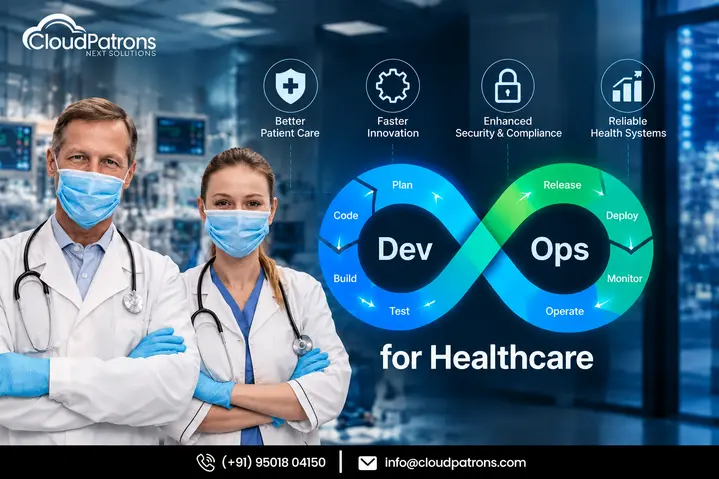
What Is DevOps, and How Does It Work in Healthcare?
DevOps in healthcare combines software development (Dev) and IT operations (Ops) into one team. Together, they build, test, and release software faster. DevOps works through three simple steps. First, it breaks down walls between development and operations teams. Second, it automates repetitive tasks like testing and deployment. Third, it uses constant feedback to catch problems early. For hospitals and telehealth apps, this means faster updates to EHR systems and patient portals. And it happens without putting patient data at risk.
What Key Challenges Does Traditional Healthcare Face Without DevOps?
1. Slow Software Updates
Fixing bugs or adding features takes weeks or months because everything is done manually — testing, approvals, deployment. Patients and doctors wait longer for improvements.
2. System Crashes During High Demand
Without auto-scaling, hospital websites and apps crash during flu season or emergencies (like vaccine rollouts) because they can't handle sudden traffic spikes.
3. Bugs Reach Doctors and Patients
Without automated testing, errors — like wrong medicine dosage suggestions — aren't caught early. Doctors discover them only after something goes wrong, which is risky for patients.
4. Slow Disaster Recovery
If a server crashes, hospitals without automated backups can lose hours or even days of patient data, and take a full day (or more) to get systems running again.
5. Manual, Error-Prone Processes
Connecting systems (like lab results to patient apps) has to be done one by one, by hand. This is slow and increases the chance of human error.
6. Poor Response During Outbreaks
During disease outbreaks (like Ebola or COVID), hospitals need fast, real-time data tracking. Without DevOps, teams often rely on spreadsheets and manual updates, causing delays in spotting problems and responding.
7. Difficulty Scaling New Services
Launching something new — like a vaccine registration portal or telehealth feature — takes much longer, sometimes over a month, and often breaks under pressure.
In short: Without DevOps managed provider, healthcare systems are slower to fix problems, more likely to crash under pressure, and slower to recover from failures — all of which puts patient care at risk. Over time, these gaps hurt patient care, raise costs, and slow down growth.
How Is DevOps Helping the Healthcare Industry in Solving Modern Problems?
DevOps fixes these problems at the source. It does this through automation, teamwork, and faster delivery. Here's how it helps:
1. Faster Digital Health Rollouts
Hospitals need to launch new digital services quickly, like telehealth, patient portals, and appointment apps. DevOps lets teams build, test, and release these in days instead of months, so patients get access to care faster.
2. Handling Sudden Demand Spikes
Modern healthcare deals with unpredictable surges — flu season, outbreaks, and vaccine drives. DevOps enables auto-scaling, so systems automatically add capacity during high traffic instead of crashing.
3. Catching Errors Before They Reach Patients
Modern healthcare software (prescriptions, dosage calculators, and diagnostic tools) can't afford mistakes. DevOps uses automated testing to catch bugs before doctors or patients are affected, reducing medical risk.
4. Real-Time Data for Outbreak Response
Diseases spread fast, and health authorities need live data to respond, like tracking Ebola or dengue cases across regions. DevOps enables real-time dashboards and continuous updates, helping teams act quickly instead of relying on manual reports.
5. Stronger Data Security & Compliance
Healthcare data (patient records, lab results) is highly sensitive. DevOps practices like automated security checks and continuous monitoring help hospitals stay compliant with regulations (like HIPAA) and catch vulnerabilities early.
6. Quick Recovery from System Failures
Hospital systems can't afford long downtimes. DevOps ensures automatic backups and fast recovery, so patient data and services are restored in minutes, not days.
7. Better Collaboration Between Teams
Doctors, IT teams, and developers often work separately, causing delays. DevOps encourages collaboration and automation between teams, so healthcare software updates smoothly without communication gaps.
8. Supporting AI & Connected Health Devices
Modern healthcare increasingly uses AI diagnostics, wearables, and IoT devices (like heart monitors). DevOps helps manage and update these complex, connected systems reliably and securely.
In short: DevOps helps healthcare move faster, stay secure, avoid downtime, and respond better to real-world problems — from daily hospital operations to disease outbreaks — ultimately improving patient safety and care.
Why Is DevOps Becoming Essential for the Healthcare Industry?
Healthcare is changing fast. mHealth apps, telemedicine, and AI-driven diagnosis are now common. Old, disconnected systems simply can't keep up. This is why DevOps for healthcare technology has become essential. It lets teams ship updates quickly, respond to security threats fast, and scale digital services like telehealth without disruption. Organizations that adopt DevOps move faster, spend less, and build more patient trust. Those that don't risk falling behind on both compliance and care quality.
What Does Recent Data Say About DevOps Adoption in Healthcare?
As per reports, 73% of healthcare organizations have adopted DevOps. That's up from 70% in 2019 and just 47% across all industries in 2017. The global DevOps market is also growing fast. It's worth $24.30 billion in 2026 and is expected to hit $125.07 billion by 2034. That's a 22.73% growth rate each year. The gap between top and bottom performers is widening too. Elite DevOps teams now deploy 182 times more often than low performers. They also see 8 times fewer failed changes and recover 2,293 times faster. In healthcare, where downtime can affect patient safety, these numbers show why DevOps can't wait.
What Are the Real-World Applications of DevOps in Healthcare?
These benefits show up in real healthcare tools every day:
- Electronic Health Record (EHR) Systems: DevOps speeds up new features and bug fixes. It also improves data flow between EHR systems.
- Telehealth and mHealth Applications: Faster development cycles support features like video visits, appointment booking, and remote monitoring.
- Medical Device Management Systems: Ongoing testing keeps medical devices safe, reliable, and easy to update.
- Personalized, AI-Driven Treatment Applications: The same DevOps pipelines power AI tools that analyze patient data for personalized care.
What Should Healthcare Organizations Consider Before Adopting DevOps?
Before rolling out DevOps, a few things need attention:
- Prioritizing Security and Compliance: Every step must follow rules like HIPAA, GDPR, and PCI DSS.
- Planning for Long-Term Sustainability: Choose tools that are easy to maintain and update over time.
- Balancing Automation With Human Oversight: Automation helps, but critical decisions still need human review.
- Working With Experienced DevOps Experts: The right partner picks better tools and trains your team well.
What Is the Step-by-Step Approach to DevOps Implementation in Healthcare?
A clear, simple process works best for DevOps rollout in healthcare .
Building a Strategic Implementation Plan
Start by reviewing your current IT setup. Look at the tools, methods, and skills you already have. This helps you spot gaps and plan the right resources. The result is a strong, working plan for DevOps rollout.
Forming Cross-Functional Teams
Next, build a team with mixed skills. Bring in DevOps engineers and healthcare experts together. This is key for handling complex healthcare systems well.
Setting Clear Goals
Set SMART goals that are specific, measurable, and realistic. Track progress along the way. Focus on goals like faster deployment, better efficiency, and full compliance.
Customizing DevOps for Healthcare
Shape your DevOps process to fit healthcare needs. Three parts matter most. Continuous integration keeps code changes smooth and error-free. Automated testing checks complex healthcare algorithms for accuracy. Continuous deployment rolls out updates while still meeting safety and compliance standards.
Integrating Strong Security Measures
Add security checks at every step, from code to launch. This protects the system from new and existing threats. It also keeps you aligned with HIPAA and GDPR.
Maintaining Continuous Monitoring
Keep watching system performance after launch. Fix small issues quickly before they grow. This keeps the system running smoothly, even during peak demand.
What Emerging Trends Are Shaping the Future of Healthcare DevOps?
Looking ahead, a few trends stand out:
- AI and Machine Learning in CI/CD Pipelines: AI now helps spot problems early and predict issues before they happen.
- Serverless and Microservice Architectures: These cut down infrastructure work and make systems easier to scale.
- Blockchain for Data Security: Blockchain keeps patient data safe and makes health records tamper-proof.
- IoT, Wearables, and Remote Patient Monitoring: Devices like smartwatches feed real-time data into EHRs for better patient insights.
How Cloud Patrons Info Solutions Helps Healthcare With DevOps
Healthcare organizations run on systems that can't afford downtime, delays, or data risk — patient portals, EHR platforms, appointment systems, and lab integrations all need to work reliably, every day. At Cloud Patrons Info Solutions, we bring DevOps expertise built for exactly this kind of high-stakes environment.
1. Reliable Cloud Infrastructure
We manage healthcare cloud environments across AWS, Azure, and hybrid setups — keeping patient-facing systems available around the clock with proactive monitoring and 24×7 NOC support.
2. Faster, Safer Deployments
Our DevOps practices automate testing and release pipelines, so healthcare software updates — like new patient features or bug fixes — go out faster, with fewer errors reaching doctors or patients.
3. Compliance-First Approach
Healthcare data is sensitive. We bring PCI DSS compliance, ISO 27001 consulting, and security audit experience to make sure DevOps pipelines don't just move fast — they stay compliant and secure.
4. Continuous Security Monitoring
With SIEM solutions, vulnerability assessments (VAPT), and round-the-clock monitoring, we help healthcare clients catch security risks before they become incidents.
5. Scalable Support for Growth
Whether it's handling seasonal traffic spikes or scaling a new digital health service, our infrastructure and automation practices are built to scale with demand — without compromising uptime.
FAQ
DevOps integrates security and compliance into the software development lifecycle through automated security testing, access controls, encryption, audit logging, and continuous monitoring. These practices help healthcare organizations support HIPAA compliance and other applicable regulatory requirements.
DevOps implementation timelines depend on infrastructure, project complexity, and organizational readiness. Initial improvements may appear within a few months, while broader transformation can take longer. Measurable benefits may include reduced deployment time, fewer software defects, lower operational costs, and improved system reliability.
Healthcare organizations should evaluate a DevOps partner based on healthcare industry experience, security expertise, knowledge of HIPAA requirements, cloud infrastructure capabilities, automation skills, and service-level agreements. It is also important to assess communication, scalability, support availability, and experience with healthcare technology systems.

Cloud Patrons Info Solutions is a prominent support provider, offering a wide spectrum of IT services. Our expertise includes Managed Cloud & Infrastructure Support, PCI DSS Implementation & Certification, and round-the-clock NOC & IT Help Desk services for a global clientele. We excel in delivering 24/7 support through various channels, serving valued customers across the globe in industries such as FinTech, Logistics, and Software. Experience top-tier support outsourcing with us.