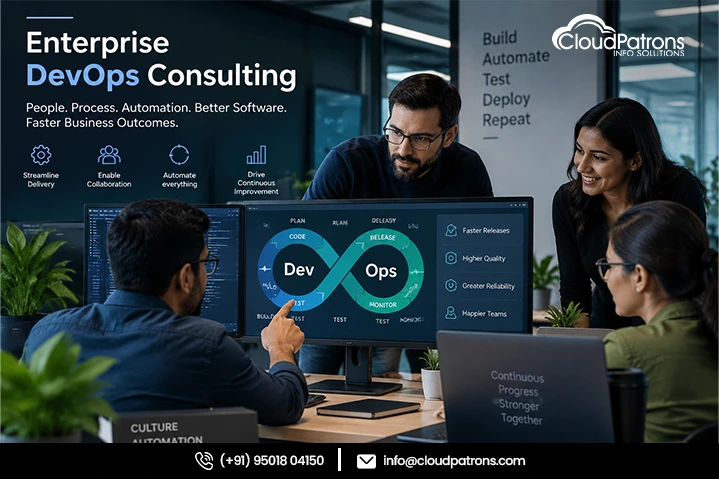
Enterprises running large-scale applications often reach a point where manual deployments, inconsistent environments, and separate teams start slowing down growth. This is where enterprise devops consulting becomes a practical necessity rather than an optional upgrade. The right consulting partner helps organizations move from random release cycles to structured, automated, and secure delivery pipelines that support long-term scalability.
How Does Enterprise DevOps Consulting Support Scalable Business Growth?
Growth introduces complexity. More users, more services, and more infrastructure mean more room for failure if processes aren't standardized. Enterprise DevOps consulting focuses on building repeatable, automated workflows that let a business scale its technology without scaling its risk in the same proportion.
Identify Your Enterprise DevOps Challenges
Most enterprises struggle devops challenges with a mix of the same issues: slow release cycles, inconsistent environments between development and production, limited visibility into system health, and fragmented tooling across teams. Identifying these bottlenecks early helps prioritize which parts of the delivery pipeline need attention first.
Assess Your Current Cloud and Delivery Infrastructure
Before making changes, it's important to understand what already exists. This means reviewing current cloud architecture, deployment methods, monitoring coverage, and how code moves from commit to production. An honest infrastructure assessment often reveals gaps that aren't visible during day-to-day operations.
Define Goals for Speed, Security, and Scalability
Every DevOps initiative should be tied to measurable outcomes — faster release cycles, reduced downtime, stronger security posture, or the ability to handle traffic spikes without manual intervention. Defining these goals upfront keeps the consulting engagement focused and outcome-driven rather than tool-driven.
Why Hire Dedicated DevOps Experts for Enterprise Transformation?
Enterprise transformation rarely succeeds with generic support. It requires people who understand large, multi-team environments and the operational constraints that come with them.
Hire DevOps Consultants for Your Specific Requirements
Dedicated devops experts bring focused experience to a specific business context instead of applying a one-size-fits-all playbook. This allows the engagement to address the actual technical debt, compliance needs, and workflow gaps unique to that organization.
Extend Your In-House Engineering Capabilities
Rather than replacing internal teams, dedicated consultants typically work alongside them — filling skill gaps in areas like automomation, container orchestration, or cloud architecture while transferring knowledge to internal engineers over time.
Access Specialized Cloud, Automation, and Security Expertise
Enterprise environments often need niche expertise that's hard to hire for permanently, such as multi-cloud automation, security hardening, or compliance-driven infrastructure design. Consulting engagements make this specialized knowledge accessible without long-term hiring commitments.
What Services Are Included in Enterprise DevOps Consulting?
- DevOps Strategy and Transformation Consulting — Building a roadmap that aligns technology practices with business objectives.
- CI/CD Pipeline Consulting and Automation — Designing pipelines that reduce manual steps and shorten release cycles.
- Cloud Infrastructure and Migration Consulting — Planning and executing migrations with minimal disruption.
- Infrastructure as Code Implementation — Making infrastructure changes version-controlled, repeatable, and auditable.
- Kubernetes and Container Consulting — Supporting container adoption and orchestration at scale.
- DevSecOps and Compliance Consulting — Embedding security checks directly into the development pipeline.
- Monitoring, Observability, and Reliability Consulting — Building visibility into system performance before issues become outages.
What Are the Key Scalable DevOps Solutions for Enterprise Environments?
Scalability isn't just about handling more traffic — it's about maintaining consistency and control as systems grow more complex.
- Automate Software Build and Deployment Workflows — Reducing manual intervention and human error in releases.
- Standardize Development and Production Environments — Eliminating "it works on my machine" issues through consistent configurations.
- Scale Applications Across Cloud and Hybrid Infrastructure — Supporting growth across public, private, or hybrid cloud setups.
- Improve Deployment Reliability and System Availability — Reducing downtime through better testing, rollback strategies, and monitoring.
How to Choose Dedicated Enterprise DevOps Experts
- Verify Enterprise DevOps Experience — Look for a track record with organizations of similar scale and complexity.
- Review Relevant Cloud and Technology Expertise — Confirm hands-on experience with the specific cloud platforms and tools in use.
- Evaluate Communication and Collaboration Practices — Assess how well the team integrates with internal stakeholders.
- Compare Engagement Models and Support Options — Understand whether support is project-based, ongoing, or hybrid.
- Measure Results Through Defined Performance Goals — Set clear KPIs from the outset to track progress objectively.
What Does the Enterprise DevOps Consulting Engagement Process Look Like?
- Discuss Your Business and Technology Requirements — Understanding current pain points and long-term objectives.
- Assess Your Existing DevOps Environment — Reviewing tooling, pipelines, and infrastructure maturity.
- Recommend a Practical Implementation Roadmap — Prioritizing changes based on impact and feasibility.
- Assign Dedicated DevOps Consulting Experts — Matching specialists to the specific technical requirements.
- Implement, Monitor, and Optimize Your Solution — Rolling out changes with continuous measurement and refinement.
Conclusion
Scaling enterprise systems reliably comes down to consistent processes, strong automation, and the right expertise guiding the transformation. Businesses that invest in structured DevOps practices are better positioned to handle growth, maintain uptime, and keep security integrated into every stage of delivery. Cloud Patrons Info Solutions works with enterprises to build and support these DevOps foundations, helping teams move toward more automated, secure, and scalable delivery pipelines.
For More Info Visit: 24×7 Cloud Security Monitoring for Threat Protection
FAQ
It's a consulting engagement where specialized DevOps professionals work directly with an enterprise to improve delivery pipelines, infrastructure, and operational practices at scale.
Typically when internal teams face bottlenecks in release speed, infrastructure complexity, or security compliance that existing resources can't resolve efficiently.
By automating repetitive processes, standardizing environments, and building infrastructure that can grow without a proportional increase in manual effort.
Yes, most engagements are designed to complement in-house engineering teams rather than operate independently of them.
Many consultants have experience across multiple cloud providers and can design strategies that work across hybrid or multi-cloud setups.

Cloud Patrons Info Solutions is a prominent support provider, offering a wide spectrum of IT services. Our expertise includes Managed Cloud & Infrastructure Support, PCI DSS Implementation & Certification, and round-the-clock NOC & IT Help Desk services for a global clientele. We excel in delivering 24/7 support through various channels, serving valued customers across the globe in industries such as FinTech, Logistics, and Software. Experience top-tier support outsourcing with us.