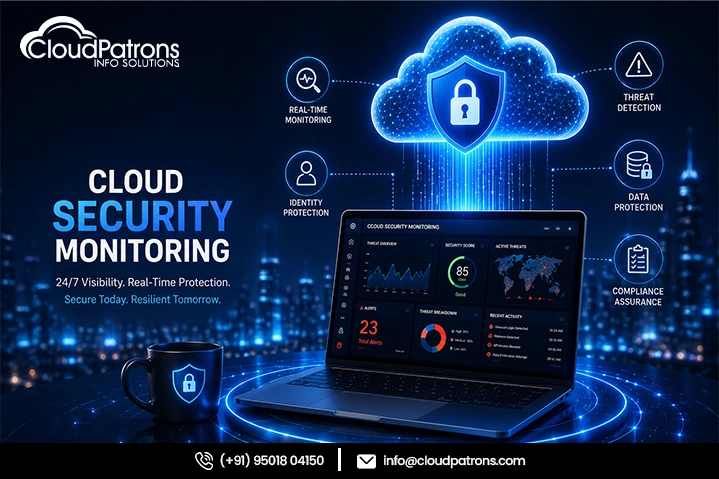
Understanding Cloud Security Monitoring in 2026
Cloud security monitoring is the ongoing collection, analysis, and correlation of information from cloud infrastructure, applications, and identity systems to identify threats and prevent them from causing damage. Cloud environments are dynamic; workloads are turned on and off, permissions are updated, data moves across regions and services, and more. With this in mind, visibility cannot be turned off; it must be on at all times. Cloud security monitoring is essentially a log analysis, behavioral detection, and automated alerting, providing businesses with a live view of what's occurring on their entire cloud footprint instead of a snapshot view every few months.
Importance of 24/7 Monitoring for Businesses
Attackers aren't around during the day, and many make a point of targeting nights, weekends, or holidays when internal teams can't be on their guard. 24x7 threat monitoring eliminates that time window by keeping watch around the clock. An attacker can move laterally within a company, gain elevated privileges, or exfiltrate data in systems that handle sensitive information — such as payment systems, fintech, or regulated industries — in just a few hours of undetected activity. One of the biggest factors in the damage and cost of a breach is the amount of time it takes to be discovered, which can be shortened by round-the-clock surveillance.
Common Threats to Cloud Security
The risks are different in cloud environments than they are in traditional on-premises environments. The most frequently occurring include:
- Unsafely exposed storage buckets or databases accessible by the public
- Phishing or social engineering attacks to obtain compromised credentials
- Unsecure APIs that expose sensitive data or functions
- Privileged account insider threats with excessive access
- Ransomware attacks on cloud-connected systems and backups
- Social engineering methods such as fake CAPTCHAs that trick users into running harmful commands
Many of these threats succeed not due to high-tech exploits but simply due to lack of visibility. It can take only a single unmonitored server or a missed permission change for an attacker to get a foothold.
Key Features of Effective Cloud Security Monitoring
Not all monitoring setups are created equal. An effective cloud security operations program typically includes:
- Real-time log collection across compute, storage, network, and identity systems
- Behavioral analysis to flag deviations from normal user or system activity
- Centralized SIEM integration to correlate events across multiple accounts and regions
- Automated alerting tied to clearly defined severity levels
- Continuous vulnerability and configuration scanning
These components work best when integrated rather than deployed in isolation. A SIEM platform without skilled analysts reviewing its output produces noise, not protection, and threat intelligence loses its value without automated correlation to act on it.
How 24/7 Monitoring Enhances Incident Response
Response speed is the determining factor in a security incident rather than detection. Once monitoring is in place, security teams can quarantine affected systems, revoke suspicious credentials, and start forensic investigation within minutes, not hours or days. This improves mean time to detect (MTTD) and mean time to respond (MTTR) metrics while also reducing the scope of damage. A well-managed monitoring program isn't just a means to flag suspicious activity — it's part of a well-defined incident response procedure so that every alert is followed by a clear path to resolution.
Implementing a Cloud Security Monitoring Strategy
The first step in developing a monitoring strategy is identifying what should be monitored and where sensitive data and critical workloads reside. Businesses typically follow a similar progression: gap assessment, deploying monitoring and logging infrastructure, implementing access controls and encryption, and finally testing the setup for validation. This isn't a one-time exercise. The cloud environment is constantly evolving, and a monitoring strategy must be reviewed regularly to reflect new services, permission changes, and emerging threats. Monitoring shouldn't be a checkbox task; it should be a discipline — it's what separates businesses that catch issues early from those that don't.
Case Studies: Success Stories in Cloud Security Monitoring
Continuous monitoring delivers results in the real world. Fingpay, a fintech processing biometric and Aadhaar-based payments, implemented 24x7 SOC monitoring and cloud security hardening, recording zero critical findings across both PCI DSS and RBI audits while achieving 99.99% uptime. Z-Credit, a digital payments provider, used a structured 90-day monitoring and remediation program to earn PCI DSS certification before the regulatory deadline with no audit observations. In another case, continuous monitoring enabled detection and containment of a fake CAPTCHA social engineering attack on an internet-facing IIS server before it could cause long-term damage, through rapid isolation, forensic investigation, and credential rotation. The common thread: proactive visibility consistently outperforms reactive response.
Conclusion: The Future of Cloud Security Monitoring
With the rise in cloud usage and the increasing sophistication of attackers, cloud security monitoring is no longer a nice-to-have — it's a must-have for any business operating in the cloud. This space is moving toward greater automation, faster incident detection through behavioral analytics, and tighter integration between monitoring and incident response. Enterprises that invest in ongoing, effective monitoring now will be far more resilient to future threats, while those that delay will continue playing catch-up after the fact.
Cloud Patrons Info Solutions offers 24/7/365 cloud security monitoring, managed SOC services, and PCI DSS compliance support to fintech, payments, and enterprise customers across 15+ countries, ensuring customers are never left blind and are always at the forefront of emerging threats.
FAQ
Cloud Security Monitoring Services continuously monitor cloud infrastructure, applications, networks, and user activity to detect suspicious behavior, security threats, vulnerabilities, and unauthorized access.
Cyber threats can occur at any time. 24×7 monitoring provides continuous visibility and helps businesses detect, investigate, and respond to suspicious activity before it causes significant damage.
It can help identify unauthorized access, compromised credentials, exposed cloud resources, ransomware activity, suspicious API behavior, privilege abuse, configuration risks, and unusual user or system activity.
Continuous monitoring enables security teams to identify threats quickly, investigate alerts, isolate affected systems, revoke suspicious credentials, and begin remediation, helping reduce detection and response times.
Businesses handling sensitive data or critical cloud workloads—including fintech, payment companies, healthcare organizations, enterprises, and regulated industries—can benefit from continuous cloud security monitoring and proactive threat protection.

Cloud Patrons Info Solutions is a prominent support provider, offering a wide spectrum of IT services. Our expertise includes Managed Cloud & Infrastructure Support, PCI DSS Implementation & Certification, and round-the-clock NOC & IT Help Desk services for a global clientele. We excel in delivering 24/7 support through various channels, serving valued customers across the globe in industries such as FinTech, Logistics, and Software. Experience top-tier support outsourcing with us.