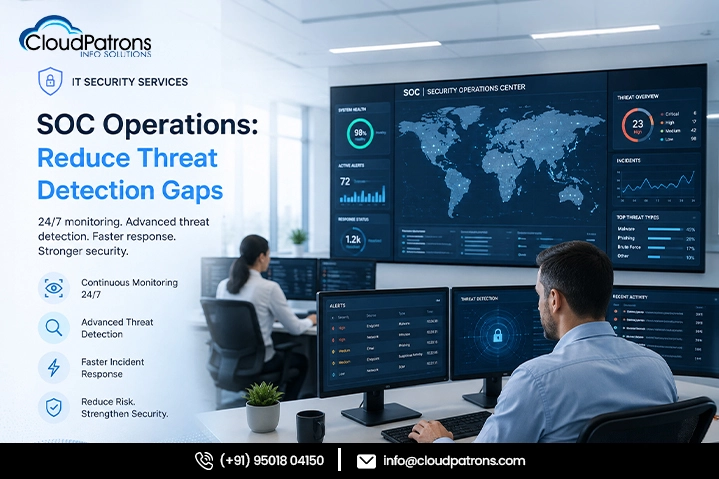
The effectiveness of a SOC is only as great as its ability to identify threats quickly and accurately. But lots of companies still face unresolved alerts, alert fatigue, and gaps in their infrastructure that enable attackers to have a day or even a week to work stealthily. That's where a strong IT security services can make a measurable impact by filling in the holes in the system, simplifying monitoring and ensuring SOC teams are ready to respond before incidents become a bigger outbreak. Improving SOC operations isn't simply a matter of acquiring more tools; it's about having the right mix of technology, skill, and process design.
Understanding Threat Detection Gaps
Detection gaps are the cases in which malicious activity goes undetected in an environment or is detected with a delay. Usually, these gaps are caused by a lack of smooth integration of logs and alerts from various systems or by the use of "legacy" rules, which are not effective at identifying newer attack methods. Another big factor is alert fatigue; with too many low-priority alerts coming in, analysts might miss the ones that are critical in the mix.
The longer a threat goes undetected, the more time an attacker has to move laterally, escalate privileges, and exfiltrate data. This dwell time, commonly known as the "dwell time," is one of the main objectives of a SOC functioning smoothly and is an important metric to track security effectiveness.
What Are The Key Areas Where SOC Operations Fall Short?
There are some common problems that affect the performance of SOC in different organizations regardless of their size:
- Siloed data sources: Security tools running independently, without centralized correlation, to see the big picture of the attack.
- Outdated threat intelligence: Threat detection rules that are not periodically updated to include active attacker tactics, techniques, and procedures.
- Limited 24/7 coverage: Lack of monitoring during off hours, weekends, or holidays when attackers are more inclined to attack.
- Manual investigation processes: Triage processes that are slow and may lead to missed incidents.
- Skill shortages: Experienced analysts with a strong ability to sift through false alarms and recognize real threats in real time.
To fill in these gaps, it is essential to have a plan that includes the appropriate technology stack, qualified staff, and established procedures.
How IT Security Services Strengthen SOC Effectiveness
There are multiple coordinated capabilities that purpose-built IT security services can help organizations close detection gaps. Centralized log management and SIEM integration help to compile logs from endpoints, networks, cloud resources, and applications into a single view for analysts to correlate events that may appear unrelated. Behavioral analytics and machine learning models extend this capability by creating a layer of "detection" that would miss anomalies completely when relying on signature-based detection alone.
Threat intelligence feeds prevent detection rules from falling behind the curve as attacks evolve; automated playbooks alleviate the burdens on analysts by automating common detection and initial containment activities. These capabilities combine to help SOCs move beyond mere monitoring and into proactive threat hunting—detecting suspicious activity before it actually becomes an incident.
In-house Vs Outsourcing, Which is Better ?
Maintaining an in-house SOC with the staff and tools to cover 24/7 operations is labor-intensive, expensive, and demands continuous training and staffing. In many companies, outsourcing their IT security needs to a managed IT security services provider is a more sensible way to fill the security detection gaps without the cost of running everything themselves.
A comprehensive IT security services firm has in place proven frameworks, analysts who are well-versed in a variety of client environments, and access to threat intelligence that can be hard to build in-house. This joint knowledge can lead to quicker detection and response times, as these teams are continually improving based on patterns they see across a wider attack spectrum and industries.
How Cloud Patrons Info Solutions Enhancing SOC Operations?
Closing the detection gap is not a one-off solution; it's a continuous process. The attackers will keep developing their tactics, and SOC operations are going to have to keep getting smarter as well, with the appropriate blend of technology, intelligence, and talent. Businesses that invest in these skills, either developing their own or by relying on trusted external firms and individuals, are much more likely to detect threats early and minimize the impact that they can have.
Cloud Patrons Info Solutions assists organizations in enhancing SOC operations by providing centralized monitoring, continuous threat detection, and quick incident response that is perfect for the fintech and enterprise landscape.
FAQ
SOC operations involve continuous security monitoring, threat detection, investigation, and incident response. Effective SOC operations help organizations identify suspicious activity early, reduce dwell time, and prevent security incidents from causing significant damage.
IT security services can strengthen SOC operations through centralized log management, SIEM integration, threat intelligence, automated response, threat hunting, and 24/7 monitoring. These capabilities help security teams reduce alert fatigue and respond to genuine threats more quickly.
Common causes include siloed security data, outdated detection rules, limited 24/7 monitoring, manual investigation processes, excessive false-positive alerts, and a shortage of skilled security analysts. These issues can allow attackers to remain undetected for longer periods.
The right choice depends on the organization's security requirements, budget, infrastructure, and available expertise. Outsourcing SOC operations to an experienced IT security services provider can provide access to skilled analysts, continuous monitoring, advanced security technologies, and threat intelligence without the cost of maintaining a full in-house SOC.

Cloud Patrons Info Solutions is a prominent support provider, offering a wide spectrum of IT services. Our expertise includes Managed Cloud & Infrastructure Support, PCI DSS Implementation & Certification, and round-the-clock NOC & IT Help Desk services for a global clientele. We excel in delivering 24/7 support through various channels, serving valued customers across the globe in industries such as FinTech, Logistics, and Software. Experience top-tier support outsourcing with us.