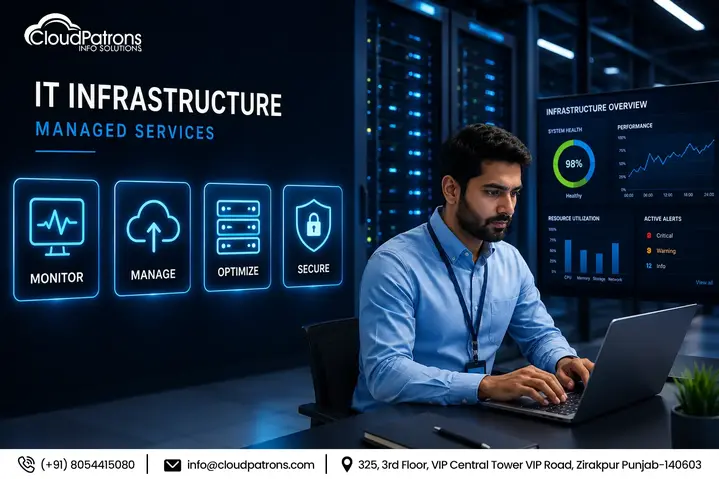
According to industry trends, managing IT infrastructure internally may seem manageable on paper, but real-world challenges often tell a different story. Unexpected server failures, the departure of experienced IT staff, and untested backup systems can expose businesses to major operational risks. For many growing companies in India, these issues have become everyday challenges, increasing the demand for IT Infrastructure Managed Services as a reliable solution for maintaining secure, scalable, and efficient technology environments.
By 2026, IT Infrastructure Managed Services have evolved beyond basic support, with advanced technologies helping businesses prevent problems before they occur. AI-driven monitoring solutions can identify early indicators of hardware failures, performance issues, and suspicious activities before they lead to downtime or security threats. Automated patch management, backups, and routine maintenance reduce human dependency and improve reliability. As a result, businesses are increasingly outsourcing the management of servers, networks, cloud platforms, and cybersecurity operations to specialized providers, enabling internal teams to focus on growth while ensuring their IT infrastructure remains stable and protected.
From Daily Challenges to Seamless IT Operations
Strip away the buzzwords and IT infrastructure managed services basically means: a third party handles the daily running, monitoring, and upkeep of your tech stack. In practice that usually looks like:
- Server and network management
- Cloud infrastructure monitoring and optimization
- Data backup and disaster recovery
- Cybersecurity monitoring and patch management
- Helpdesk and end-user support
- Performance reporting and capacity planning
The real value isn't the list itself — it's the timing. A good provider catches problems before they cause downtime, instead of showing up after the damage is already done.
Why Businesses Are Moving Away from Traditional IT Teams
A few years back, hiring your own IT staff was just the default move. That logic doesn't hold up as well anymore, and not for one single reason.
The cost is finally predictable
Salaries, benefits, training, and the inevitable day someone quits mid-project — that's the real cost of in-house IT, and it's rarely fixed. Managed services usually run on a flat monthly fee, which makes budgeting a lot less of a guessing game.
You get a whole bench, not one hire
Nobody is simultaneously a networking expert, a cloud architect, a security specialist, and a compliance person. A managed provider brings all of that at once, so you're not stuck with whatever one or two employees happen to know.
Problems get caught faster
With round-the-clock monitoring, issues often get fixed before your team even notices anything was wrong. Compare that to waiting until 9 AM for someone to log in and check.
Growth doesn't require a hiring sprint
Infrastructure needs change as the business does, and managed services scale with that — no recruiting cycle, no onboarding lag, no scrambling.
The Indian IT Landscape and the Need for Managed Support
India's business environment has moved fast — maybe faster than most internal IT teams could keep up with. Startups, mid-sized firms, even older manufacturing companies are now running hybrid or cloud-first setups, and the complexity that comes with that doesn't slow down for anyone.
This is the exact challenge that managed IT support providers in India are addressing. Local experts have a deeper understanding of regional requirements, including inconsistent power infrastructure, the need to scale operations cost-effectively, data residency regulations, and the ongoing challenge of retaining skilled IT professionals in a competitive job market.
There's also a practical upside to going local: support in your own time zone, familiarity with frameworks like RBI guidelines for FinTech, and faster boots-on-ground response for the kind of problems that can't be fixed remotely.
Key Factors to Consider Before Choosing IT Support Services in India
Every provider claims to be reliable. The difference shows up the first time something genuinely breaks. When you're comparing IT support services India options, a few things matter more than the sales pitch:
Real uptime numbers
Not a percentage on a slide — ask for historical data from clients in your industry.
Security that's built in, not bolted on
With threats increasing across every sector, monitoring shouldn't be a line item you can opt out of.
SLAs you can actually read
Response times, resolution times, escalation steps — all written down, not explained after something already went wrong.
Experience with businesses like yours
A provider who's worked with FinTech or healthcare clients will already understand the compliance headaches that come with those industries.
Room to grow without a rebuild
Whether you're at 20 people or heading toward 200, the infrastructure model shouldn't need to be torn up and redone every time you scale.
How CloudPatrons Helps Businesses Build Future-Ready IT Infrastructure
Choosing the right managed service provider is critical to achieving these benefits. CloudPatrons Info Solutions helps businesses simplify IT management with reliable infrastructure support, cloud solutions, cybersecurity services, proactive monitoring, and 24/7 technical assistance. With expertise in managing modern IT environments, CloudPatrons enables organizations to improve performance, reduce downtime, and scale their infrastructure confidently without the burden of handling every technical challenge internally.
For businesses looking to stay competitive in 2026 and beyond, partnering with an experienced IT infrastructure managed services provider is no longer just an operational decision — it is a strategic investment in business continuity, security, and long-term growth.
Real-World Success Story: How Fingpay Improved Infrastructure Reliability and Security with CloudPatrons Info Solutions
Fingpay: Strengthening 24/7 Security and Infrastructure Reliability
Fingpay required a robust technology environment capable of supporting continuous operations while maintaining strong security standards. CloudPatrons Info Solutions provided proactive monitoring, infrastructure management, security improvements, and ongoing technical support to ensure operational stability. This approach helped Fingpay improve system reliability, minimize risks, and maintain a secure IT infrastructure that supports business continuity.
Result Achieved:
- Delivered 99.99% uptime for AePS and micro-ATM transaction services.
- Achieved an MTTR of less than 15 minutes through proactive monitoring and efficient incident management.
- Demonstrated strong security governance by successfully completing PCI DSS and RBI audits with no critical issues.
- Increased confidence among financial institutions and partners, enabling Fingpay to scale its merchant ecosystem.
The Future of Managed IT Services in India
Managed services were never really about outsourcing the boring stuff. They represent a different way of thinking about technology — moving it from a cost center you tolerate to something that actively supports growth instead of getting in its way.
For businesses across India still weighing build-versus-outsource, the direction is fairly clear at this point. Bringing in an experienced managed services partner isn't about losing control of your systems. It's about getting the expertise and the round-the-clock attention that keeps everything running, so your team can spend their time on work that actually moves things forward.
Also Read Our New Blog: 24x7 Cybersecurity MSPs: Secure Your Business Today!
FAQ
Managed IT services onboarding typically includes discovery, IT assessment, planning, tool deployment, security setup, system optimization, user training, testing, go-live, and continuous monitoring to ensure efficient and reliable IT support.
The core components of IT infrastructure managed services typically include network management, server monitoring, cloud management, cybersecurity, data backup and recovery, IT support, system maintenance, software updates, performance monitoring, and infrastructure optimization to ensure secure, reliable, and efficient IT operations.
Outsourcing IT infrastructure management provides cost savings, expert support, improved security, scalability, reduced downtime, proactive maintenance, and allows businesses to focus on core operations.
The core components of modern IT infrastructure requiring management include networks, servers, cloud platforms, storage systems, cybersecurity, databases, applications, endpoints, and backup solutions to ensure performance, security, and reliability.
IT infrastructure managed services pricing models include per-device, per-user, flat-rate monthly, tiered packages, pay-as-you-go, and customized pricing based on business requirements.

Cloud Patrons Info Solutions is a prominent support provider, offering a wide spectrum of IT services. Our expertise includes Managed Cloud & Infrastructure Support, PCI DSS Implementation & Certification, and round-the-clock NOC & IT Help Desk services for a global clientele. We excel in delivering 24/7 support through various channels, serving valued customers across the globe in industries such as FinTech, Logistics, and Software. Experience top-tier support outsourcing with us.