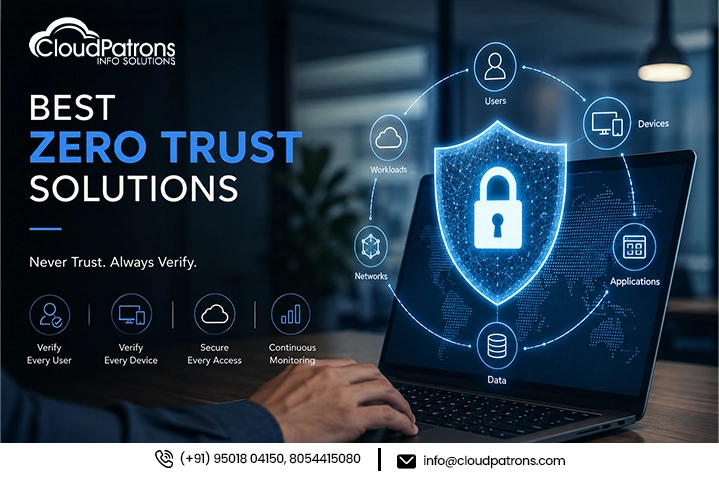
The old network wall is disappearing. Cloud adoption, remote work, and third-party access have changed how businesses connect. Workers, contractors, and vendors now log in from everywhere, and none of them sit safely behind a single office firewall anymore. This is why best zero trust solutions matter so much today. This guide covers what zero trust means, how it works, its key features and benefits, the main solution types, and how to choose among zero trust companies the right way for your business.
What Is Zero Trust Security?
Zero trust follows one rule: never trust, always verify. It checks every user and device, every time. It does not assume anyone inside the network is safe. This model relies on continuous authentication and least-privilege access, unlike old perimeter-based security. Many teams follow NIST SP 800-207 as their guide.
How Does Zero Trust Security Work?
- Verifies every user and device before granting access
- Applies least-privilege access at all times
- Checks device security and context before allowing entry
- Monitors sessions and behavior continuously
- Limits access to specific apps, not the whole network
- Reassesses trust whenever risk conditions change
Key Features of the Best Zero Trust Solutions
- Identity and Access Management (IAM) for centralized control
- Multi-Factor Authentication (MFA) beyond passwords
- Least-privilege access based on user roles
- Device posture checks before access is granted
- Micro-segmentation to isolate workloads
- Continuous monitoring and analytics
- Application-level access instead of full network access
- Support across cloud, hybrid, and on-site environments
Types of Zero Trust Solutions
Zero Trust Network Access (ZTNA)
ZTNA providers give access to specific apps, not the full network. This is why many teams choose ZTNA over traditional VPNs.
Identity-Centric Zero Trust
This model uses IAM, MFA, roles, and context to control access, treating identity as the new security perimeter.
Micro-Segmentation Solutions
These solutions isolate critical apps, workloads, and data into small zones to limit damage from a breach.
SASE with Zero Trust
SASE combines networking and cloud security in one service, bringing together ZTNA, CASB, SWG, and FWaaS.
Zero Trust for Cloud Workloads
These tools protect cloud apps, containers, and workloads at every stage of their lifecycle.
ZTNA vs Traditional VPN: What's the Difference?
VPNs grant network-level access, while ZTNA grants application-level access. ZTNA adds identity-based controls, better visibility, and stronger scalability for remote teams, with far less security exposure than a VPN.
What to Look for in the Best ZTNA Solutions
- Strong IAM and MFA integration
- Device posture checking
- Granular, role-based access policies
- Real-time monitoring and reporting
- Cloud and SaaS integrations
- Easy scalability and simple user experience
How to Evaluate Zero Trust Companies & ZTNA Providers
- Experience with enterprise-level security
- Integration with your existing security stack
- Cloud, hybrid, and on-premises capabilities
- Compliance expertise and implementation support
- SLA terms and incident response speed
- Vendor reputation and customer track record
How to Choose the Best Zero Trust Solution
Start by assessing your existing infrastructure. Map out your cloud, on-premises, SaaS, and remote access environments so you know what you're protecting. Next, identify your critical assets. Decide which applications, workloads, and data need the strongest protection first. Then understand your users, including employees, administrators, contractors, vendors, and other third parties who need access.
Define clear access policies that state who needs access to what, and under which conditions. Check compatibility with your existing IAM, MFA, SIEM, and endpoint security tools before you commit. Confirm the solution supports your compliance requirements, such as PCI DSS. Compare implementation costs, ongoing management, and future scalability across vendors. Finally, run a pilot deployment to test security, integrations, and user experience before you roll it out company-wide.
Common Zero Trust Implementation Challenges
- Legacy infrastructure that's hard to integrate
- Poorly defined access policies
- User resistance to new workflows
- Limited internal security expertise
- Low visibility across cloud environments
Zero Trust for PCI DSS & Regulated Businesses
Fintech and payment companies need strong identity verification, least-privilege access, network segmentation, and continuous monitoring to stay PCI DSS compliant. A structured zero trust approach makes this achievable at scale.
Managed Zero Trust vs In-House Implementation
In-house zero trust works when you have strong internal security expertise. For most businesses, working with an MSSP offers 24x7 monitoring, specialized expertise, and ongoing optimization without the internal overhead.
Why Choose Cloud Patrons Info Solutions for Zero Trust
Cloud Patrons Info Solutions designs and implements zero trust architecture for fintech, payments, and enterprise clients. We handle IAM and access security, micro-segmentation, and cloud workload protection across cloud, hybrid, and on-site environments. Our team brings deep PCI DSS compliance expertise, backed by 24x7 NOC and SOC monitoring for continuous threat detection and response.
Zero trust is a security strategy, not a single product. The best fit depends on your infrastructure, users, risks, and compliance needs. Start with your highest-risk applications and expand from there. Contact Cloud Patrons Info Solutions to build a scalable zero trust plan for your business.
FAQ
Zero Trust is a security approach based on the principle of “never trust, always verify.” It does not automatically trust users or devices based on their location. Instead, every access request is verified before permission is granted.
Popular Zero Trust access solutions include Google BeyondCorp, Microsoft Azure AD Conditional Access, Okta Access Gateway, Zscaler Zero Trust Exchange, Cisco Duo Beyond, and F5 Access. The right solution depends on an organization’s security requirements and IT environment.
Zero Trust improves cloud security by verifying user identities before granting access and applying user-based access rules. It can also improve network visibility and help reduce the risk of unauthorized access and data breaches.
Traditional perimeter-based security assumes that users inside the network can be trusted. Zero Trust takes a different approach by continuously verifying access instead of relying only on network location. This makes it better suited to cloud environments and remote work.
Zero Trust solutions verify users and devices before providing access to business resources. This approach helps organizations control access, monitor activity, and protect systems even when employees and devices operate outside the traditional corporate network.
Cloud Patrons Info Solutions is a prominent support provider, offering a wide spectrum of IT services. Our expertise includes Managed Cloud & Infrastructure Support, PCI DSS Implementation & Certification, and round-the-clock NOC & IT Help Desk services for a global clientele. We excel in delivering 24/7 support through various channels, serving valued customers across the globe in industries such as FinTech, Logistics, and Software. Experience top-tier support outsourcing with us.