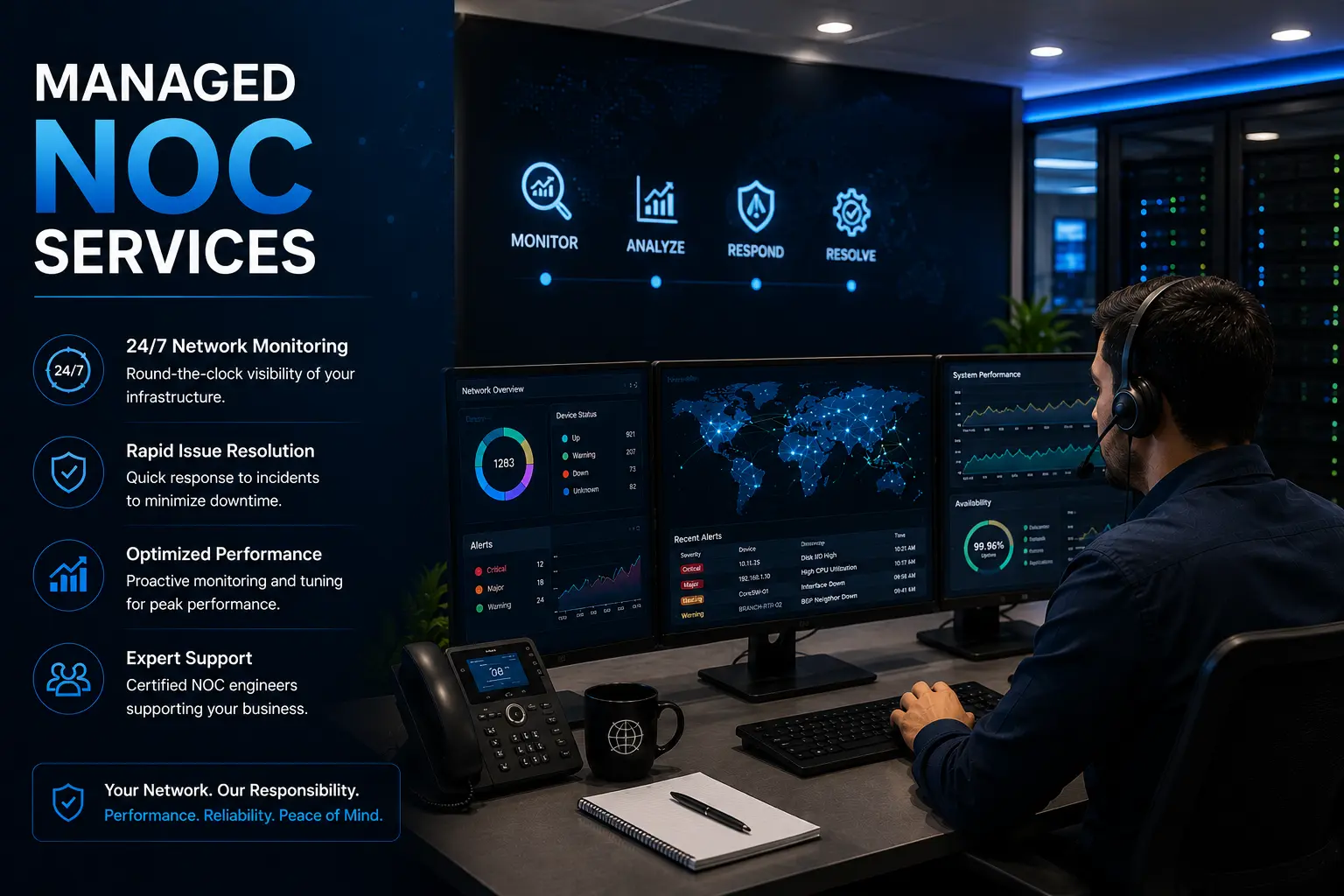
Modern businesses run on networks the same way cities run on electricity. The moment connectivity fails, operations stop, employees panic, customers complain, and revenue starts leaking quietly in the background. That’s exactly why managed NOC services have become a mission-critical investment for businesses and Managed Service Providers (MSPs) alike.
In 2026, companies are no longer asking whether they need proactive network monitoring. They are asking how quickly they can implement reliable 24x7 NOC services without exploding operational costs. At the same time, MSPs are aggressively adopting outsourced and white-label msp noc services to scale faster, reduce technician burnout, and deliver enterprise-grade uptime.
Industry reports show the global managed services market continues to expand rapidly, fueled by AI-driven automation, cybersecurity concerns, hybrid cloud infrastructure, and rising demand for always-on IT operations.
Before diving deep into implementation, benefits, pricing, and strategy, here’s the complete article structure.
What Are Managed NOC Services?
A Network Operations Center (NOC) serves as the main control center for monitoring and managing an organization’s IT infrastructure, including servers, cloud platforms, firewalls, applications, endpoints, and network performance. When these responsibilities are handled by external experts, they are called managed NOC services. Businesses rely on proactive NOC monitoring because even minor downtime can affect productivity, operations, and customer trust. Unlike standard IT support limited to business hours, 24x7 NOC services provide continuous monitoring, issue resolution, and incident response. Managed NOC providers support hybrid environments, cybersecurity systems, virtual infrastructure, and white-label services, helping businesses maintain security, operational efficiency, and uninterrupted IT performance.
Understanding the Role of a Network Operations Center
The main role of a NOC is to keep networks stable and business operations uninterrupted. Engineers monitor uptime, latency, CPU usage, storage capacity, packet loss, and security alerts, then resolve issues before they grow. Traditional IT support reacts after failures occur, while managed NOC services focus on preventing them. Many companies choose managed NOC or managed services NOC models to avoid the cost of building a 24/7 team in-house.
A NOC managed service provider uses monitoring software, automation, ticketing systems, analytics dashboards, and AI-driven alert management. Strong NOC managed services and NOC services give complete visibility and reduce operational risk. Whether you select NOC service providers or managed NOC service providers, look for skilled engineers and clear escalation paths. Every managed NOC service should also include a dependable managed NOC tool.
IT companies often rely on NOC services for MSP teams that lack round-the-clock staff. MSP NOC services, MSP NOC, and NOC for MSP partnerships add night coverage without extra hiring, while MSP NOC support helps meet SLAs. Some providers offer white label NOC services under the MSP's own brand, and a few adopt a managed managed NOC model. This makes NOC services for MSPs a practical way to scale.
Outsourced NOC services, outsourced NOC, and outsourced NOC monitoring suit businesses that want expert coverage without the overhead. Before signing, run a managed NOC comparison across managed NOC vendors, and review each managed NOC solution for tooling, response times, and reporting. Compare managed NOC pricing and NOC services pricing by scope, not only by the headline figure, so you choose the right partner.
How Managed NOC Services Work
Most managed NOC providers begin by integrating monitoring tools into the client’s IT infrastructure. Once connected, the NOC team receives real-time alerts and performance data from servers, endpoints, networks, applications, and cloud environments.
The process generally includes:
- Continuous monitoring
- Alert detection
- Incident analysis
- Troubleshooting and remediation
- Escalation when needed
- Reporting and optimization
The best providers also offer service-level agreements (SLAs), ensuring rapid response times and guaranteed uptime commitments.
Why Businesses Need 24x7 NOC Services
Modern businesses operate around the clock, making 24x7 NOC services essential for uninterrupted IT performance. With customers across time zones, remote workforces, always-on cloud applications, and rising cyber threats, organizations cannot afford downtime.
Continuous monitoring helps NOC teams detect and resolve issues before customers are affected. Like a security team constantly guarding digital infrastructure, NOC services provide proactive support, improved cybersecurity resilience, and cost-efficient IT operations for businesses managing increasingly complex environments.
Why MSPs Are Investing in NOC Services
Managed Service Providers struggle to meet 24/7 support, uptime, cybersecurity, and cloud demands internally. Outsourced NOC services let MSPs scale efficiently without extra staff, partnering with expert teams behind the scenes.
Scaling Operations Without Hiring Large Internal Teams
Hiring experienced network engineers is expensive and increasingly difficult. MSPs across the world report ongoing talent shortages and rising operational costs.
Managed NOC partnerships help solve this challenge by providing:
- 24/7 monitoring coverage
- After-hours support
- Escalation management
- Alert remediation
- Infrastructure maintenance
- Patch monitoring
- Backup verification
This allows MSPs to serve more clients while maintaining operational efficiency.
White-Label NOC Services for MSP Growth
White-label NOC services help MSPs deliver enterprise-grade support under their own brand, enabling smaller providers to scale efficiently, reduce technician burnout, and compete with larger firms without heavy infrastructure investments.
Core Features of Managed NOC Services
The value of NOC services comes from continuous operational oversight and proactive infrastructure management. While service offerings vary by provider, most comprehensive NOC solutions include several critical capabilities.
Real-Time Infrastructure Monitoring
Continuous monitoring enables NOC teams to track servers, firewalls, cloud workloads, and applications in real time, detect issues instantly, reduce downtime, and improve overall system reliability and operational performance.
Incident Management and Alert Resolution
Modern NOC providers use intelligent filtering to reduce alert fatigue, prioritize critical incidents, investigate root causes, apply remediation procedures, and escalate major issues quickly to maintain efficient IT operations and system stability.
Patch Management and Maintenance
Unpatched systems create security vulnerabilities and operational instability. NOC providers manage updates, patches, firmware upgrades, and maintenance schedules to keep systems secure and optimized.
Backup and Disaster Recovery Monitoring
Backups are useless if they fail silently. Managed NOC teams verify backup integrity, monitor recovery systems, and ensure disaster recovery procedures remain functional.
This adds an additional layer of resilience for business continuity planning.
How 24x7 NOC Services Improve Business Continuity
Business continuity depends heavily on operational stability. Companies cannot afford constant interruptions, especially in industries where digital systems directly affect customer experience and revenue generation.
Faster Incident Response
A 24/7 NOC environment ensures incidents are detected and addressed immediately, regardless of time zone or business hours.
Instead of waiting until employees arrive in the morning, issues are already being resolved overnight. Faster response times reduce business impact significantly.
Reduced Downtime and Improved Productivity
Reliable infrastructure enables employees to remain productive and customers to access services without interruption.
It also reduces pressure on internal IT teams. Rather than constantly reacting to emergencies, internal staff can focus on strategic initiatives like cloud transformation, automation, and cybersecurity improvements.
Cost Comparison
Building an internal NOC requires major investments in staffing, monitoring platforms, infrastructure, training, and operational management.
Managed NOC providers distribute these costs across multiple clients, making services more affordable and scalable.
Skills and Expertise Comparison
Managed providers often employ specialized engineers with experience across multiple technologies, industries, and environments.
This broader exposure improves troubleshooting efficiency and operational maturity.
Emerging Trends in Managed NOC Services for 2026
The NOC landscape is evolving rapidly. AI, automation, cloud computing, and cybersecurity are reshaping how network operations function.
AI-Powered Network Operations
AI-driven monitoring platforms help MSPs predict failures, automate repetitive tasks, improve efficiency, and lower costs, while self-healing infrastructure automatically restarts services, reroutes traffic, and triggers remediation workflows without human involvement.
Hybrid Cloud and Multi-Cloud Monitoring
Modern businesses increasingly use hybrid and multi-cloud environments. NOC providers monitor AWS, Azure, Google Cloud, SaaS applications, and on-premise systems together, making unified visibility essential for maintaining operational consistency and infrastructure performance.
How to Choose the Right NOC Services Provider
Choosing a provider is not just about pricing. Businesses should evaluate technical expertise, scalability, response times, communication quality, and security capabilities.
Important evaluation criteria include:
- 24/7 monitoring availability
- SLA commitments
- Escalation procedures
- Tool integrations
- Cybersecurity expertise
- Reporting transparency
- Automation capabilities
- White-label support for MSPs
Industries That Benefit Most From NOC Services
Healthcare, finance, retail, manufacturing, and MSPs heavily rely on NOC services for continuous monitoring, secure operations, system uptime, and scalability, making NOC support essential for modern digital transformation and infrastructure stability.
Conclusion
Technology infrastructure is vital for business continuity, making managed NOC services essential for stability, security, and uninterrupted operations. Businesses and MSPs rely on outsourced and white-label MSP NOC services for 24x7 monitoring, rapid response, and reduced operational workload. Modern network operations now use AI-driven monitoring, predictive analytics, proactive remediation, and hybrid cloud visibility to improve uptime and cybersecurity resilience. Organizations adopting advanced NOC strategies gain stronger infrastructure reliability, lower operational risks, enhanced customer experiences, and long-term operational efficiency with trusted providers like CloudPatrons Info Solutions.
FAQ
Managed NOC services are outsourced network monitoring and IT infrastructure management solutions that provide continuous monitoring, incident response, and operational support for businesses and MSPs.
24x7 NOC services ensure that network issues are detected and resolved immediately, reducing downtime, improving uptime, and protecting business continuity.
MSP NOC services are specialized NOC solutions designed for Managed Service Providers. They help MSPs deliver continuous monitoring and support without building large in-house teams.
They allow MSPs to expand service offerings, onboard more clients, provide after-hours support, and reduce operational overhead without hiring additional staff.
Healthcare, finance, retail, manufacturing, logistics, SaaS companies, and MSPs benefit significantly from continuous infrastructure monitoring and proactive network management.
Cloud Patrons Info Solutions is a prominent support provider, offering a wide spectrum of IT services. Our expertise includes Managed Cloud & Infrastructure Support, PCI DSS Implementation & Certification, and round-the-clock NOC & IT Help Desk services for a global clientele. We excel in delivering 24/7 support through various channels, serving valued customers across the globe in industries such as FinTech, Logistics, and Software. Experience top-tier support outsourcing with us.