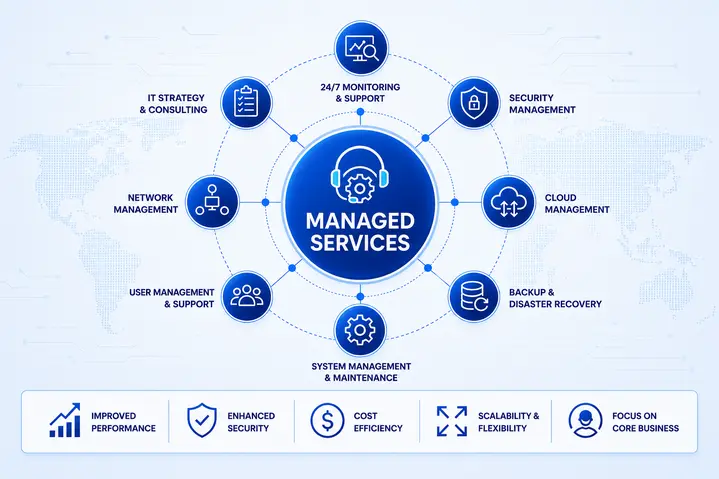
Every growing business eventually hits the same wall: technology needs outpace what a small internal team can realistically cover. Servers need patching at 2 a.m., a phishing attempt needs triage before it spreads, a new hire needs a laptop provisioned by Monday — and none of it waits for business hours.
Outsourcing IT through a managed services provider (MSP) means paying a third-party company a recurring fee to monitor, maintain and support your technology infrastructure instead of building and running that capability entirely in-house. The core benefits are predictable costs, access to specialized expertise without full-time salaries, faster issue resolution through 24/7 monitoring, and reduced security and compliance risk. Most businesses see the biggest impact in freed-up internal time and a lower total cost of IT ownership — not just "cheaper labor."
At Cloud Patrons Info Solutions, we sit on the delivery side of this decision every day, supporting fintech, payments and enterprise clients across 15+ countries with managed cloud infrastructure, 24×7 NOC monitoring, PCI DSS compliance and cybersecurity operations. This guide is written from that vantage point — what actually gets measured, what gets missed and how to evaluate the decision properly instead of taking a vendor's word for it.
What Does Outsourcing IT Through Managed Services Actually Mean?
"IT outsourcing" and "managed services" get used interchangeably, but they aren't the same thing. IT outsourcing is a broad term that can mean anything from a one-off project (build us a new website, migrate this database) to full offshore staffing. Managed services is narrower and more specific: it's a subscription-based, proactive support model where a provider continuously monitors and maintains your systems under an ongoing contract, rather than being called in only when something breaks.
A typical MSP scope includes network monitoring, helpdesk support, cybersecurity operations, cloud infrastructure management and backup/disaster recovery — delivered continuously, not episodically. The market reflects this shift: global demand for managed IT services has grown steadily over the past decade as businesses move away from reactive, break-fix support toward always-on operational partnerships.
Managed Services vs. Traditional IT Outsourcing vs. In-House IT
An in-house IT model offers complete control through an internal team but requires significant investment in salaries, infrastructure and training. While it works well for organizations with complex or proprietary systems, scaling is slower and expertise is limited to existing employees. Traditional IT outsourcing focuses on hiring external providers for specific projects or tasks, making it a cost-effective option for short-term requirements. However, it lacks continuous support, proactive monitoring and long-term scalability. Managed Services (MSPs) provide ongoing IT management through predictable subscription pricing, 24/7 monitoring, SLA-backed support and access to specialists across cloud, cybersecurity, networking and infrastructure. For organizations seeking a balance, Co-managed IT combines an internal IT team with an MSP, allowing businesses to retain strategic control while benefiting from additional expertise, flexible scaling, after-hours support and enhanced security. The best choice depends on factors such as budget, compliance needs, growth plans, required expertise and the level of operational control the business wants to maintain.
Core Benefits of Outsourcing IT to a Managed Services Provider
Predictable, Lower Total Cost of IT Ownership
A flat-fee or subscription MSP contract replaces the unpredictable cost swings of in-house IT: recruiting, onboarding, training, turnover, emergency repairs and scattered software licensing. Consider a 50-person company weighing one in-house IT hire — salary, benefits, training and tooling — against an MSP contract covering the same scope with a broader team behind it. The MSP model rarely wins purely on sticker price; it wins because it converts a variable, spiky cost into a predictable line item, while covering specialties a single hire never could.
Access to Specialized Expertise and Broader Skill Coverage
This is the "bench strength" argument: an MSP employs network engineers, security analysts and cloud architects as a team, not a single generalist wearing every hat. When evaluating a provider, credibility signals worth checking include vendor certifications and partnerships (Microsoft, Cisco, AWS) and hands-on compliance experience — not just marketing claims. A two-person internal IT team can keep the lights on, but it's rarely equipped to run a full cybersecurity incident response on its own. That's exactly the gap Cloud Patrons' dedicated security and NOC teams are built to cover for clients who don't have — and don't want to build — that bench internally.
Proactive Monitoring and Reduced Downtime
The difference between reactive "break-fix" support and proactive monitoring is the difference between finding out about a problem from an angry customer versus an automated alert. 24/7 network monitoring, patch management and automated alerting catch issues before they cascade into outages. This is where SLA response-time benchmarks matter — a provider promising 99.9% uptime with tiered response windows for critical incidents gives you something concrete to hold them to, rather than a vague promise of "great support."
Improved Cybersecurity and Compliance Posture
Standard MSP security offerings now typically include managed detection and response (MDR), endpoint protection and regular vulnerability assessments. For regulated industries, compliance support matters as much as the technical coverage — frameworks like HIPAA, SOC 2 and PCI DSS require ongoing evidence, not a one-time audit. Small and mid-sized businesses remain disproportionately targeted by attackers precisely because they're assumed to have weaker security operations than larger enterprises — which is exactly the assumption a strong MSP partnership is meant to remove. For fintech and payment platforms specifically, PCI DSS implementation isn't optional, and it's one of the areas we work most closely on with clients at Cloud Patrons — treating compliance as a continuous operating discipline rather than a once-a-year scramble.
Scalability Without Hiring Cycles
MSP contracts flex with the business — up during growth, down during quieter periods — without a recruiting lag. Onboarding 20 new employees' devices and accounts happens in days under a managed model, versus weeks with a stretched internal team trying to do it alongside everything else already on their plate.
Freeing Internal Teams for Strategic, Revenue-Generating Work
Perhaps the most underrated benefit: when routine monitoring, patching and helpdesk tickets move to an MSP, internal IT staff — where they exist — stop firefighting and start working on projects that actually move the business forward: architecture decisions, product-supporting infrastructure and process improvements. The value isn't just cost savings; it's redirecting scarce internal attention toward work only your team can do.
Red Flags to Watch for When Choosing an MSP
Not all providers deliver on the promise above. Before signing:
- Vague SLAs—"We'll get to it quickly" is not a commitment; look for specific uptime percentages and tiered response times in writing.
- No compliance track record — if you need PCI DSS, HIPAA or SOC 2 support, ask for evidence of prior implementations, not just a checkbox on a services page.
- Opaque pricing — "starting at" quotes that balloon once you ask for an itemized breakdown are a signal to keep looking.
- No clear escalation path — ask exactly who handles a critical incident at 3 a.m., and how fast.
- Lock-in without exit terms — a provider unwilling to spell out data portability and offboarding terms is telling you something about the relationship they intend to have.
Conclusion
Outsourcing IT through managed services isn't about handing off responsibility — it's about converting unpredictable, reactive IT operations into a predictable, proactively monitored function backed by specialists your business couldn't otherwise afford to hire individually. The businesses that get the most out of this model are the ones that go in with a clear framework: knowing whether they need fully managed, co-managed, or a targeted mix, and holding providers accountable to specific, measurable SLAs rather than vague promises.
That accountability is the standard Cloud Patrons Info Solutions builds every engagement around—24×7 NOC monitoring, PCI DSS compliance, cybersecurity operations, and managed cloud support delivered as one coordinated partnership, not a patchwork of disconnected vendors. If you're weighing in-house versus managed versus co-managed IT for your business, book a free consultation, and we'll help you map out which model actually fits where you are today.
Also Visit:
Managed IT Support: How Cloud Patrons is Shaping IT Operations in India
Managed IT Support Services: Best Practices for Secure and Scalable IT Operations
Affordable Cyber Security Service Pricing Guide | Cloud Patrons
Managed Cloud Computing Services: The Complete Guide to Transforming Your IT Infrastructure
FAQ
A Managed Services Provider (MSP) is a third-party company that proactively manages and supports an organization's IT infrastructure through a subscription-based model. Services typically include 24/7 monitoring, cybersecurity, cloud management, helpdesk support, backups, disaster recovery, and ongoing maintenance to keep business systems secure and operational.
Managed IT services help reduce costs by replacing unpredictable IT expenses with a fixed monthly fee. Instead of hiring multiple in-house specialists, businesses gain access to experienced professionals across cloud, networking, and cybersecurity while minimizing downtime, emergency repairs, and recruitment costs.
Yes, outsourcing IT to a reputable Managed Services Provider can improve security. Most MSPs offer services such as continuous network monitoring, endpoint protection, vulnerability assessments, threat detection, regular patch management, and compliance support for standards like PCI DSS, HIPAA, and SOC 2, helping businesses reduce cybersecurity risks.
Your business should consider outsourcing IT if your internal team struggles with growing technology demands, frequent downtime, cybersecurity concerns, compliance requirements, or limited IT expertise. Managed Services are particularly beneficial for businesses looking to scale efficiently, improve system reliability, and allow internal teams to focus on strategic business initiatives instead of day-to-day IT maintenance.
Cloud Patrons Info Solutions is a prominent support provider, offering a wide spectrum of IT services. Our expertise includes Managed Cloud & Infrastructure Support, PCI DSS Implementation & Certification, and round-the-clock NOC & IT Help Desk services for a global clientele. We excel in delivering 24/7 support through various channels, serving valued customers across the globe in industries such as FinTech, Logistics, and Software. Experience top-tier support outsourcing with us.