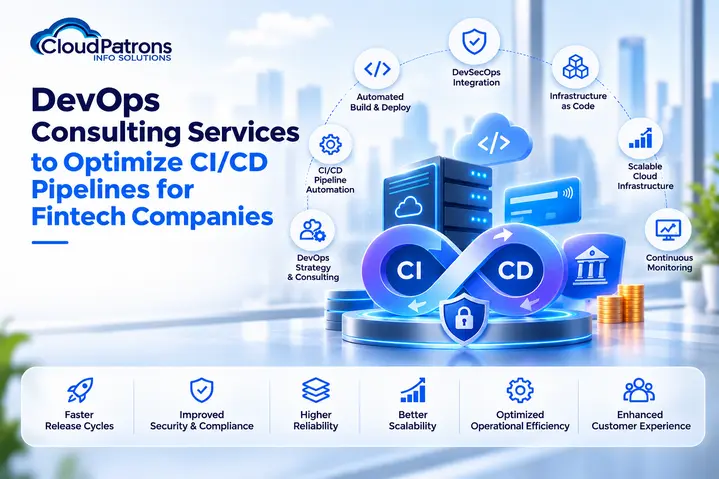
The fintech industry depends on secure, reliable, and efficient technology to deliver financial services. From digital payments and online banking to financial transactions, fintech companies must continuously improve their platforms while maintaining security and operational stability. However, traditional software development and manual deployment processes often create delays, increase operational risks, and limit scalability.
This is where DevOps consulting services play an important role. By integrating development, operations, and security practices, DevOps helps fintech businesses automate software delivery, streamline CI/CD pipelines, and improve infrastructure performance. With the right DevOps consulting services and solutions, fintech companies can accelerate software releases while maintaining security, reliability, and regulatory readiness.
What Are DevOps Consulting Services for Fintech Companies?
DevOps consulting services help fintech companies improve software development, deployment, and infrastructure management through automation and continuous collaboration. These services focus on reducing manual processes, strengthening development workflows, and ensuring consistent software delivery.
DevOps consultants evaluate existing IT infrastructure, identify operational challenges, and implement strategies that improve efficiency. They help organizations develop automated CI/CD pipelines, adopt cloud technologies, integrate security practices, and monitor system performance.
For fintech companies handling financial transactions and sensitive customer information, DevOps consulting supports secure and reliable software operations while enabling faster adaptation to changing business requirements.
Why Are CI/CD Pipelines Important for Fintech Companies?
Continuous Integration and Continuous Delivery (CI/CD) pipelines automate software development activities, including code integration, testing, validation, and deployment. They allow development teams to introduce updates consistently without depending entirely on manual processes.
In fintech environments, even minor software errors can affect payment processing, customer access, or transaction reliability. CI/CD pipelines help identify issues before deployment by performing automated tests and validation checks.
Continuous Integration ensures that code changes are regularly tested, while Continuous Delivery prepares verified updates for controlled production releases. Together, these practices help fintech businesses maintain software quality, improve deployment consistency, and minimize operational disruptions.
What CI/CD Pipeline Challenges Do Fintech Companies Face?
Fintech companies operate in complex technology environments where security, system availability, and regulatory requirements are essential. Without properly configured CI/CD pipelines, organizations may experience several operational challenges.
Manual deployment processes can increase human errors and delay software releases. Inconsistent development and production environments may create unexpected application failures.
Security vulnerabilities, inadequate testing, and weak access controls can also expose sensitive financial systems to unnecessary risks. Additionally, growing transaction volumes may place pressure on infrastructure that lacks proper scalability.
Regulatory requirements add another layer of complexity, requiring organizations to maintain appropriate security controls, deployment records, and audit evidence.
Professional DevOps consulting services help address these challenges through automation, infrastructure standardization, and continuous monitoring.
How Do DevOps Consulting Services Improve CI/CD Pipelines for Fintech Companies?
DevOps consulting services and solutions improve CI/CD pipeline efficiency by combining deployment automation, continuous testing, cloud infrastructure management, and integrated security.
-
Automated Integration and Deployment: DevOps consultants implement automated pipelines using technologies such as Jenkins, GitHub Actions, and GitLab CI. These workflows streamline code integration, testing, and deployment while reducing repetitive manual activities.
-
Security Integration Through DevSecOps: Security checks are incorporated throughout the development process. Automated vulnerability scanning, dependency analysis, and access controls help identify potential security issues before production deployment.
-
Infrastructure as Code: Tools such as Terraform and AWS CloudFormation enable organizations to manage infrastructure through reusable configurations. This approach improves environment consistency, reduces configuration errors, and supports repeatable deployments.
-
Automated Testing and Release Management: Unit testing, integration testing, and regression testing help validate software changes. Controlled deployment strategies and rollback mechanisms further reduce the risk of disruption during releases.
-
Continuous Monitoring: Automated alerts, infrastructure monitoring, and centralized logging provide visibility into deployment failures and application performance, allowing teams to identify and resolve issues efficiently.
Together, these capabilities help fintech companies create reliable software delivery processes while supporting business growth.
How Do DevOps Consulting Services Strengthen Fintech Security and Compliance?
Security is a major consideration for fintech businesses because their technology environments often process sensitive financial and customer information.
DevOps consulting services integrate security practices into CI/CD workflows through automated code scanning, secure configuration management, and controlled access permissions.
For companies within the scope of PCI DSS, DevOps practices can support compliance efforts by maintaining deployment records, implementing security checks, and improving infrastructure visibility. However, automated pipelines alone do not guarantee regulatory compliance.
Integrating security throughout development helps fintech companies identify vulnerabilities earlier, improve traceability, and maintain stronger control over software changes.
What Are the Benefits of DevOps Consulting Services for Fintech Companies?
Implementing DevOps consulting services offers several advantages for financial technology businesses.
-
Faster Software Releases: Automated development and deployment workflows reduce repetitive activities and help teams deliver updates more efficiently.
-
Improved Reliability: Continuous testing, deployment validation, and monitoring help reduce software failures and improve operational stability.
-
Enhanced Security: Integrated security controls support early vulnerability detection and more consistent development practices.
-
Better Scalability: Cloud infrastructure automation and resource optimization help businesses adapt to increasing transaction volumes.
-
Operational Efficiency: Standardized processes reduce manual workloads and allow technical teams to focus on innovation and service improvement.
These benefits help fintech companies maintain dependable technology operations while responding to changing customer expectations.
How Does Cloud Patrons Help Fintech Companies Optimize CI/CD Pipelines?
Cloud Patrons Info Solutions provides cloud and DevOps services designed to improve infrastructure management, deployment efficiency, and operational reliability.
Through DevOps consulting services and solutions, Cloud Patrons helps businesses streamline CI/CD workflows, implement infrastructure automation, integrate security practices, and improve cloud performance.
Its services cover CI/CD pipeline development, Infrastructure as Code, cloud infrastructure optimization, monitoring, and DevSecOps practices. These capabilities can support fintech companies seeking more consistent deployment processes and scalable technology environments.
By aligning DevOps practices with business and infrastructure requirements, Cloud Patrons helps organizations establish efficient software delivery workflows and strengthen operational resilience.
Conclusion
DevOps consulting services play an important role in helping fintech companies optimize CI/CD pipelines through automation, continuous testing, security integration, and cloud infrastructure management. These practices support faster software delivery, improved reliability, and greater operational efficiency.
With professional DevOps consulting services and solutions from Cloud Patrons Info Solutions, fintech businesses can improve deployment consistency, strengthen infrastructure security, and build scalable technology environments that support long-term business growth.
FAQ
AWS DevOps consulting services help fintech companies automate CI/CD pipelines, streamline software deployments, and improve cloud infrastructure management. They support continuous integration, automated testing, security monitoring, and scalable environments, enabling financial technology businesses to deliver software updates more efficiently and reliably.
A DevOps-focused AWS consulting company helps fintech startups establish automated deployment workflows, implement cloud infrastructure, and integrate security practices from the early development stages. These services support faster product releases, reduced manual errors, better resource utilization, and scalable business operations.
An AWS DevOps consultant evaluates existing development workflows, identifies infrastructure challenges, and implements automation strategies. Their responsibilities include CI/CD pipeline configuration, Infrastructure as Code, cloud monitoring, security integration, and deployment optimization to improve software delivery and operational reliability.
Enterprise DevOps consulting services improve CI/CD pipelines through automated testing, standardized deployment processes, Infrastructure as Code, and continuous monitoring. These practices help fintech enterprises manage complex environments, reduce deployment failures, maintain consistent software quality, and support large-scale financial operations.
Yes. An AWS DevOps company can integrate automated security testing, access controls, vulnerability scanning, and audit logging into CI/CD pipelines. These practices help fintech companies strengthen infrastructure security and support applicable compliance requirements, including PCI DSS, although they do not independently guarantee compliance.
Cloud Patrons Info Solutions is a prominent support provider, offering a wide spectrum of IT services. Our expertise includes Managed Cloud & Infrastructure Support, PCI DSS Implementation & Certification, and round-the-clock NOC & IT Help Desk services for a global clientele. We excel in delivering 24/7 support through various channels, serving valued customers across the globe in industries such as FinTech, Logistics, and Software. Experience top-tier support outsourcing with us.