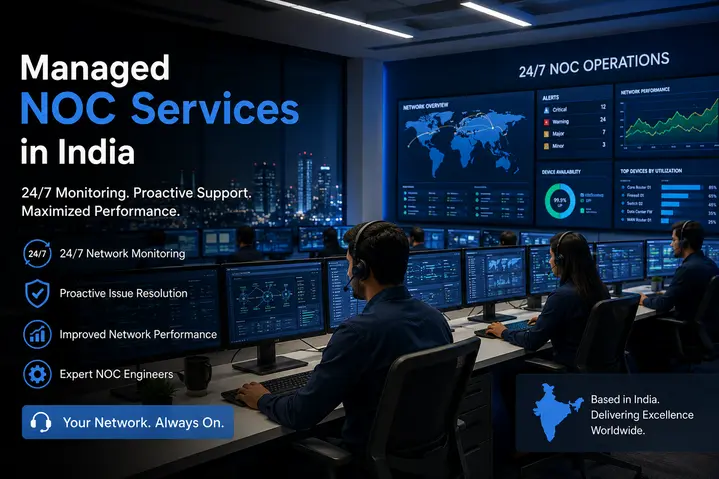
What Managed NOC Services Are and How They Work
A Network Operations Center, or NOC, is a centralized function that monitors and manages network health, performance, and availability. In a managed model, the provider takes ownership of monitoring, alerting, incident triage, and many routine remediation tasks instead of simply notifying your internal team when something breaks.
The practical value of managed NOC services is proactive support. Systems are watched continuously, abnormal behavior is identified early, and issues can often be contained before they affect users, branches, applications, or customer-facing services.
Managed NOC services usually include:
- 24/7 monitoring of routers, switches, firewalls, servers, cloud resources, and internet links
- Alert correlation to reduce noise and prioritize real incidents
- Initial troubleshooting and escalation based on predefined thresholds
- Performance tracking, reporting, and service-level visibility
- Support for cloud, hybrid, and distributed infrastructure environments
Managed NOC vs. Break-Fix Support
Break-fix support waits for a user to report a problem. Managed NOC services are designed to detect issues earlier and respond in a structured way, which is especially important when outages affect multiple offices, remote teams, or customer-facing workloads.
For businesses with high uptime expectations, the difference is not just operational. It also affects customer experience, internal productivity, and the predictability of IT costs.
Why Proactive Monitoring Matters
Most network incidents begin as warning signs such as latency, packet loss, device overload, or link instability. A managed NOC is useful because it focuses on catching these signals before they become business interruptions.
Why Ownership Matters
A real managed service does more than send alerts. It defines who investigates, who escalates, and what actions are taken first. This helps reduce confusion during incidents and improves response discipline.
Why Managed NOC Services Matter for Businesses in India
For Indian businesses, the need for managed NOC services is often driven by distributed operations, hybrid work, cloud adoption, and the expectation that digital services should remain available beyond normal office hours.
When teams rely on multiple internet links, SaaS applications, branch connectivity, or cloud infrastructure, even a small network issue can disrupt revenue and operations.
This is especially relevant for organizations that operate across time zones, support remote users, or run business-critical systems where downtime affects sales, customer support, compliance, or production workflows.
Managed NOC services help businesses:
- Support 24/7 operations without building a full internal round-the-clock team
- Reduce response delays during after-hours incidents
- Improve visibility across branch, cloud, and hybrid environments
- Standardize escalation and reporting
- Reduce operational pressure on internal IT teams
Business Benefits of Managed NOC Services
Business Need |
What a Managed NOC Helps With |
Practical Benefit |
|---|---|---|
After-hours support |
Round-the-clock monitoring and escalation |
Less downtime outside office hours |
Multi-site network visibility |
Centralized oversight of devices and links |
Faster identification of where the issue sits |
Cloud and hybrid environments |
Monitoring across on-premise and cloud resources |
Better continuity across modern infrastructure |
Lean IT teams |
Routine monitoring and first-level remediation |
IT staff can focus on projects instead of constant alert handling |
What a Strong Managed NOC Provider Should Deliver
A credible managed NOC provider should offer more than basic monitoring. The service should be structured around clear responsibilities, measurable response commitments, escalation paths, reporting, and security controls that fit your environment.
The most useful providers combine monitoring tools with operational discipline. That includes accurate alerting, documented incident workflows, and reporting that helps leadership understand recurring problems instead of only seeing isolated incidents.
Core Capabilities to Expect
The exact scope may vary, but mature managed NOC services should usually cover continuous monitoring, incident handling, performance analysis, and regular reporting.
In many environments, they also help with configuration changes, patch coordination, and preventive maintenance support.
If your network includes cloud services, VPNs, firewalls, endpoints, or voice and video infrastructure, the provider should be able to monitor across those layers instead of treating each one in isolation.
Monitoring and Alert Management
The NOC should filter noise, correlate related alerts, and prioritize issues based on business impact. This prevents your team from being overloaded by false positives.
Incident Response and Escalation
A strong NOC follows predefined runbooks for triage, escalation, and containment. This shortens the time from alert to action.
Reporting and SLA Visibility
Regular reporting should show incident trends, response times, recurring faults, and service-level performance so stakeholders can measure value clearly.
Questions to Ask Before You Buy
Decision-makers should ask how the provider handles severity levels, what tools they use, how they document incidents, and whether they can integrate with existing IT workflows.
These questions matter because the best technical monitoring is still ineffective if the operational process is unclear.
You should also understand how access is controlled, how logs are handled, and how the provider supports business continuity if a monitoring platform or communication channel fails.
Evaluation Area |
Question to Ask |
|---|---|
Visibility |
Can your team see alerts, tickets, and performance data in real time? |
Ownership |
Does the provider only notify, or do they actively investigate and help resolve issues? |
|
|
Are access controls, audit trails, and data handling practices clearly defined? |
How to Choose the Right Managed NOC Model
The right model depends on your internal IT maturity, business criticality, and the complexity of your environment.
Some organizations need full outsourced monitoring and response, while others only need extended-hour coverage, overflow support, or monitoring for specific infrastructure segments.
A practical way to decide is to compare the cost of incidents and downtime against the cost of coverage. If your team frequently misses alerts after hours, spends too much time on routine monitoring, or cannot maintain consistent response times, outsourcing part of the NOC function is often more practical than hiring for every shift internally.
Common managed NOC models include:
Trade-Offs to Consider
Outsourcing improves coverage and access to specialized processes, but it also requires trust, documentation, and clean handoffs. The provider should not create a black box where your internal team loses situational awareness.
The goal is not to remove internal control. The goal is to build a model where the provider handles monitoring and first response while your team retains governance, architectural decisions, and business alignment.
Factor |
Explanation |
|---|---|
Benefit |
Better continuity, faster response, and less operational burden on internal staff |
Trade-off |
Requires clear SLAs, escalation rules, and structured communication to prevent confusion |
Common Use Cases for Managed NOC Services
Managed NOC services are most valuable where network uptime directly affects business operations. This includes organizations with multiple branches, distributed users, cloud-based apps, VoIP systems, online customer portals, and compliance-sensitive environments.
They are also useful during periods of change, such as office expansion, migration to hybrid cloud infrastructure, or major network refresh projects. The monitoring layer helps teams catch instability early.
Common use cases include:
Best Practices for Implementing Managed NOC Services Successfully
Successful implementation starts with scope. Define which systems are in scope, which events are considered critical, who receives escalations, and what actions the provider is allowed to take without approval.
The next step is alignment on reporting and review. Monthly or weekly reporting should show incident patterns, root causes, recurring devices, and opportunities to eliminate repeat failures rather than only closing tickets.
Implementation Steps That Reduce Friction
Start with a discovery of your network architecture, business hours, critical applications, and escalation chain. Then agree on monitoring thresholds, ticket workflows, and communication methods before going live.
A phased rollout is usually safer than switching everything at once, especially if your environment includes legacy devices, multiple vendors, or custom routing and security rules.
Define Service Scope Clearly
List devices, links, applications, and locations that must be monitored so there is no ambiguity during incidents.
Document Escalation Paths
Specify who gets notified for low, medium, and critical events, and how quickly each severity level must be acted on.
Review Reports Regularly
Use incident trends and root-cause data to reduce repeat issues instead of treating every alert as a one-off event.
Common Mistakes Businesses Make When Buying Managed NOC Services
The most common mistake is choosing a provider only on price. Low-cost monitoring can leave gaps in response quality, reporting, expertise, or escalation discipline.
Another mistake is assuming all NOC services are the same. In practice, there is a major difference between basic alert forwarding and a managed service that actively investigates, documents, and coordinates resolution.
Common mistakes include:
Expert Insights for Decision-Makers in India
For Indian enterprises and mid-market businesses, the biggest value of managed NOC services is operational consistency. A well-run NOC reduces dependence on individual staff availability and creates a repeatable way to respond to incidents across locations and shifts.
The strongest service providers usually combine technical monitoring with clear process maturity. That means they can explain not just what they monitor, but how they respond, how they escalate, and how they help prevent the same problem from recurring.
Decision-makers should:
Why Choose Cloud Patrons for Managed NOC Services in India?
Choosing Cloud Patrons for Managed NOC Services in India gives your business a reliable partner for continuous monitoring, faster incident response, and better uptime. Instead of depending only on reactive troubleshooting, Cloud Patrons helps you identify network, server, cloud, and security issues early so they can be addressed before they disrupt operations. With expertise across managed cloud services, cybersecurity, DevOps, PCI DSS compliance, NOC monitoring, and FinTech infrastructure, Cloud Patrons understands the operational needs of businesses where availability and security are critical. Its 24/7 monitoring approach reduces pressure on internal IT teams while improving visibility, escalation, and response discipline. For businesses that want stronger infrastructure performance without building a full in-house NOC, Cloud Patrons offers a practical and scalable solution. If your goal is to protect uptime, improve operational control, and support business growth, Cloud Patrons is a trusted Managed NOC Services partner to consider
FAQ
Managed NOC services in India are outsourced network monitoring and response services that help businesses watch critical infrastructure 24/7, detect issues early, and coordinate remediation before downtime spreads.
Regular monitoring often stops at alerts, while managed NOC services usually include triage, incident handling, escalation, reporting, and ongoing operational support.
Managed NOC services are a strong fit for businesses with multiple locations, cloud or hybrid infrastructure, after-hours operations, or teams that cannot reliably monitor and respond to alerts all day and night.
Ask about coverage hours, response times, escalation rules, reporting, access control, security practices, and whether the provider only monitors or also helps resolve incidents.
Yes. Many businesses use a co-managed model where the provider handles monitoring and first response while the internal team retains strategic control and deeper infrastructure ownership.
Cloud Patrons Info Solutions is a prominent support provider, offering a wide spectrum of IT services. Our expertise includes Managed Cloud & Infrastructure Support, PCI DSS Implementation & Certification, and round-the-clock NOC & IT Help Desk services for a global clientele. We excel in delivering 24/7 support through various channels, serving valued customers across the globe in industries such as FinTech, Logistics, and Software. Experience top-tier support outsourcing with us.